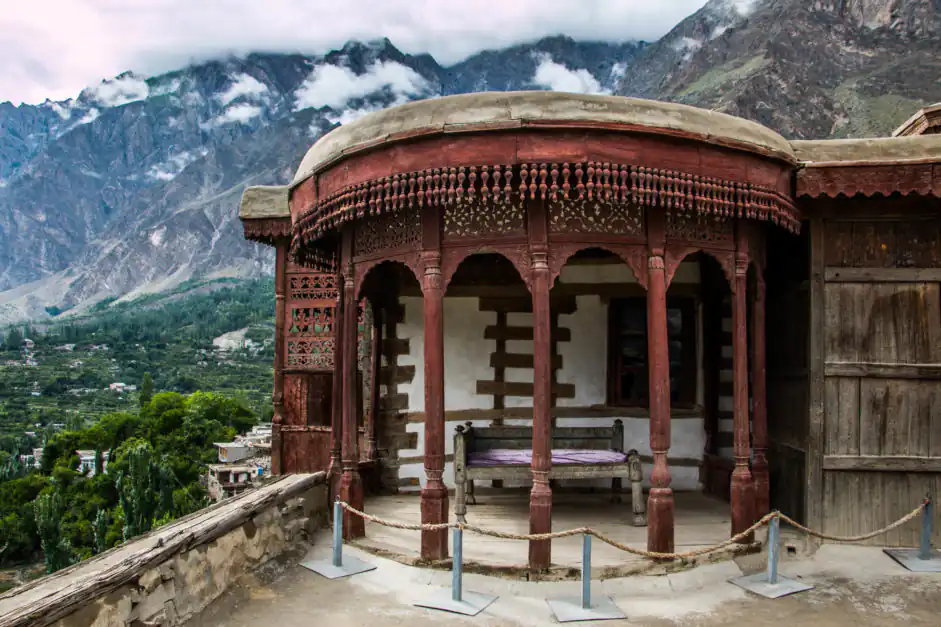
High above the rooftops of Karimabad, a centuries-old fortress seems to grow directly out of the mountainside.
This is Baltit Fort, one of the most important historical landmarks in Hunza Valley, Pakistan.
With its weathered stone walls, timber balconies and commanding position overlooking the valley, Baltit Fort looks very different from the grand palaces and forts found in cities such as Lahore. Its architecture belongs to the high mountains — practical, defensive and shaped by centuries of life in the Karakoram.
For foreign travelers visiting northern Pakistan, Baltit Fort offers something particularly valuable. Hunza is famous for mountains, glaciers and turquoise lakes, but visiting the fort helps you understand the people and history behind the landscape.
Baltit Fort once served as the residence of the rulers of Hunza and remained occupied by the Mir of Hunza until 1945. Today, the restored fort functions as a heritage site and cultural attraction overlooking Karimabad.
This Baltit Fort travel guide covers its history, architecture, what you can see inside, how to reach it, the best time to visit and practical tips for international tourists exploring Hunza Valley.
Where Is Baltit Fort?
Baltit Fort is located above Karimabad in Hunza Valley, in Pakistan’s Gilgit-Baltistan region.
Karimabad itself was formerly known as Baltit and served as the historic center of the former Hunza State.
The fort occupies an elevated position above the settlement, below the mountains and glaciers surrounding the valley.
Its location was not chosen simply because it looked beautiful.
From the fort, the rulers of Hunza had extensive views across the surrounding valley and important approaches through the mountains. UNESCO describes its position as strategically important for controlling seasonal trans-Karakoram trade between South and Central Asia.
Today, that strategic location gives visitors one of the best panoramic views in Karimabad.
How Old Is Baltit Fort?
Baltit Fort is often described as being around 700 years old, but the complete history of the structure is more complicated.
UNESCO’s documentation notes that conservation work carried out during the 1990s found that the oldest core of the complex may date to around the eighth century AD. That original defensive stone-and-timber tower was expanded considerably over later centuries, eventually developing into the multi-level fort visitors see today.
The Government of Gilgit-Baltistan describes Baltit Fort as the home of Hunza’s ruling family for roughly 700 years.
So rather than imagining the fort as a building constructed at one moment in history, it is better to think of Baltit as a structure that evolved over many generations.
Different rulers modified and expanded it as Hunza’s political circumstances, defensive needs and cultural connections changed.
That layered history is one of the reasons the building is so fascinating.
A Brief History of Baltit Fort
For centuries, Hunza was a mountain principality ruled by hereditary rulers known as Mirs.
Baltit Fort became their principal residence and political center.
From its elevated position, the ruling family could oversee settlements, agricultural terraces, trade routes and movement through the valley.
Hunza’s geographical position placed it close to historic routes connecting the Indian subcontinent, Central Asia and China. This meant the region was relatively remote but never completely isolated.
During the nineteenth century, Hunza also became involved in the geopolitical rivalry commonly known as the Great Game, when the British and Russian empires competed for influence across Central and South Asia.
In 1891, British forces invaded Hunza as part of their wider strategy in the region. Baltit Fort consequently witnessed one of the most significant political transitions in Hunza’s modern history.
The Mir continued to use the fort as a residence until 1945, after which it was abandoned as a royal home.
Without conservation, centuries of weather, earthquakes and structural deterioration could eventually have resulted in the loss of the building.
Instead, Baltit Fort received one of Pakistan’s most significant heritage restoration projects.
Restoration of Baltit Fort
The restoration of Baltit Fort was undertaken through the Aga Khan Trust for Culture and associated conservation initiatives.
The project involved much more than simply repainting walls.
Conservators had to stabilize a centuries-old building constructed with traditional timber and masonry techniques in a region vulnerable to earthquakes.
The restoration was completed in 1996, after several years of work.
Traditional building knowledge was combined with modern conservation techniques, while craftsmen and local communities were involved in preserving the character of the structure.
The project later received the UNESCO Asia-Pacific Heritage Conservation Award for Excellence in 2004. The award recognized not only the conservation of the fort itself but also the project’s role in reviving traditional construction skills and encouraging heritage preservation across northern Pakistan.
Today, Baltit Fort functions as a museum and cultural center rather than a royal residence.
Is Baltit Fort a UNESCO World Heritage Site?
This is an important distinction, especially because it is often described incorrectly online.
Baltit Fort is not currently an inscribed UNESCO World Heritage Site.
It has been included on Pakistan’s UNESCO World Heritage Tentative List since January 30, 2004.
A Tentative List contains sites a country may consider nominating for World Heritage status in the future.
So the accurate description is:
Baltit Fort is on Pakistan’s UNESCO World Heritage Tentative List.
It should not be described as a UNESCO World Heritage Site unless its status changes in the future.
Architecture of Baltit Fort
One of the most interesting things about Baltit Fort is how different it looks from many other famous forts in Pakistan.
There are no vast ceremonial gardens or enormous sandstone gateways.
Instead, Baltit was designed for a high-altitude mountain environment.
The building rises from a large stone base and incorporates extensive timber construction, balconies, small windows and interconnected rooms.
UNESCO describes the fort as a rectangular, three-storey structure built on a high stone plinth. Its lower sections historically contained storage spaces, while upper levels included reception rooms, living quarters, kitchens, guest rooms and audience halls.
Timber was particularly important.
Traditional wooden frameworks helped reinforce the stone walls in an area regularly affected by seismic activity.
The result is a building that feels inseparable from its environment.
It doesn’t look like a palace transported into the mountains.
It looks as though it belongs there.
What Can You See Inside Baltit Fort?
Walking through Baltit Fort gives you a much clearer sense of how the ruling family once lived.
Rather than enormous palace halls, expect relatively compact spaces connected by narrow stairways, passages and wooden doorways.
Historic rooms help illustrate how different areas of the building were used for everyday life, administration, receiving guests and seasonal living.
UNESCO’s architectural description identifies spaces that historically served as storage chambers, audience halls, guest rooms, dining areas, kitchens, bedrooms and reception rooms.
But some of the most memorable moments come when you reach the upper parts of the fort.
Step outside or look through the openings and the entire valley suddenly appears below you.
Karimabad spreads across the slopes while enormous mountains surround the settlement.
It becomes immediately obvious why this particular hill was chosen.
The View From Baltit Fort
Even travelers with little interest in history should visit Baltit Fort for the view.
Its elevated position provides sweeping panoramas across Hunza Valley and the surrounding Karakoram mountains. The Government of Gilgit-Baltistan specifically highlights the fort’s panoramic views as one of its major attractions.
On a clear day, the combination of mountains, orchards, terraced fields and traditional settlements creates one of Karimabad’s classic views.
Photographers should allow more time than they initially expect.
The scenery changes constantly depending on cloud cover and light.
How to Reach Baltit Fort
Getting to the general area is easy once you are staying in Karimabad.
The final approach involves walking uphill through the older part of the settlement toward the fort.
You cannot expect to step out of a vehicle directly beside the entrance.
And that is actually a good thing.
The walk through Karimabad helps create a gradual transition from the modern tourist center toward the historic fort.
You’ll pass shops, homes, cafés and narrow streets before the fortress finally appears above you.
The climb can feel surprisingly tiring if you have recently arrived from lower elevation, so walk slowly and allow yourself plenty of time.
How Much Time Do You Need at Baltit Fort?
For most visitors, allow approximately one to two hours for the fort itself.
History enthusiasts and photographers may want longer.
Don’t schedule your visit too tightly.
Part of the experience is taking time to examine the rooms, listen to explanations and enjoy the views rather than simply walking through the building as quickly as possible.
You should also allow additional time for the walk through Karimabad before and after your visit.
Best Time to Visit Baltit Fort
Baltit Fort can form part of a Hunza itinerary throughout much of the main tourism season, but the experience changes dramatically with each season.
Spring brings blossoming fruit trees across Hunza, often with snow-covered peaks still visible behind the valley.
Summer generally offers warmer temperatures and easier travel throughout the region, although it is also one of the busiest periods.
Autumn may be the most photogenic season. Trees around Karimabad turn shades of yellow, orange and red while the mountains remain dramatically visible above them.
Winter transforms Hunza again, but colder temperatures and changing road conditions make travel less predictable.
For many first-time foreign visitors, April through October offers the greatest flexibility for including Baltit Fort within a wider Hunza Valley trip.
Best Time of Day for Photography
Try visiting either earlier in the day or later in the afternoon if photography is important to you.
Midday mountain light can be harsh.
Softer morning and afternoon light tends to reveal more texture in the fort’s timber and stone construction while making the surrounding mountains look more dramatic.
Autumn is particularly beautiful because the warm colors of the trees contrast strongly with the stone fortress and mountain backdrop.
Even if you visit during the middle of the day, however, the elevated position still provides excellent landscape photography opportunities.
What to Wear When Visiting Baltit Fort
You don’t need specialist equipment.
Comfortable walking shoes are far more important than fashionable footwear because reaching the fort involves uphill walking and uneven surfaces.
Mountain weather can also change quickly.
For most visits, useful items include:
- Comfortable walking shoes
- Light jacket or warm layer
- Sunglasses
- Sunscreen
- Water bottle
- Camera or smartphone
- Some Pakistani rupees for small purchases and situations where cards aren’t accepted
Dress relatively modestly, as you would elsewhere when visiting communities and cultural attractions in northern Pakistan.
Baltit Fort vs Altit Fort
Visitors frequently ask whether they should visit Baltit Fort or Altit Fort.
The answer is simple:
Visit both if you have time.
They provide different experiences.
Baltit Fort is larger, visually dominant and deeply associated with the rulers of Hunza.
Altit Fort, meanwhile, is another major historic site nearby and is considered older than the later royal complex at Baltit. The Government of Gilgit-Baltistan describes Altit as a centuries-old fort overlooking the Hunza River and one of the valley’s major heritage attractions.
Because the two attractions are relatively close, visiting both helps you understand the historical development of Hunza far better than visiting either one alone.
A good plan is to dedicate part of one day to Baltit Fort, Altit Fort and old Karimabad, then finish with sunset from a higher viewpoint such as Duikar.
Other Places to Visit Near Baltit Fort
Baltit Fort fits naturally into a wider Hunza Valley itinerary.
After exploring Karimabad, continue toward Altit Fort and the historic settlement around it.
Higher above Karimabad, Duikar offers excellent sunrise and sunset views.
If you are traveling north through Hunza, the road eventually leads toward Attabad Lake, Gulmit, Hussaini, Passu and Khunjerab Pass.
That means Baltit Fort works particularly well near the beginning of a Hunza trip.
Start with the valley’s history.
Then head north into its mountains.
Tips for Foreign Tourists Visiting Baltit Fort
Karimabad is accustomed to both Pakistani and international visitors, so visiting the fort is relatively straightforward.
However, there are a few things worth remembering.
Do not rush uphill immediately after arriving in Hunza, particularly if you have traveled from Islamabad or another low-altitude destination.
Respect photography restrictions inside historical rooms if staff ask you not to take pictures.
Listen to a guide if one is available. Without historical context, some rooms may simply look like old wooden spaces. Once their purpose and history are explained, the building becomes considerably more meaningful.
Most importantly, remember that Baltit Fort is not simply a background for photographs.
It represents centuries of Hunza’s political and cultural history.
Treating it as a heritage site rather than just an Instagram location will make your visit much more rewarding.
Is Baltit Fort Worth Visiting?
Yes.
If you’re visiting Hunza Valley for the first time, Baltit Fort should be near the top of your itinerary.
Hunza’s mountains will probably be what initially attracts you to the region.
Baltit Fort helps explain the civilization that developed among those mountains.
It adds history, architecture and human stories to landscapes that might otherwise be experienced only through viewpoints and photographs.
The visit is also relatively easy to incorporate into a stay in Karimabad.
You don’t need an entire day.
You don’t need hiking equipment.
And you don’t need to travel deep into a remote valley.
Yet within a few hours, you can experience one of northern Pakistan’s most important surviving historical structures.
Frequently Asked Questions About Baltit Fort
Where is Baltit Fort located?
Baltit Fort is located above Karimabad in Hunza Valley, Gilgit-Baltistan, Pakistan.
How old is Baltit Fort?
The fort is commonly described as around 700 years old as a royal complex, although conservation research identified an older structural core that may date to around the eighth century AD.
Who lived in Baltit Fort?
Baltit Fort served as the residence of the Mir, or ruler, of Hunza and the ruling family for centuries. The Mir continued living there until 1945.
Is Baltit Fort a UNESCO World Heritage Site?
No. Baltit Fort is currently on Pakistan’s UNESCO World Heritage Tentative List, where it has been listed since January 30, 2004.
Why is Baltit Fort famous?
Baltit Fort is famous for its history as the former royal residence of Hunza, its distinctive mountain architecture, its restoration and its panoramic location overlooking Karimabad and Hunza Valley.
Who restored Baltit Fort?
The fort was restored through the Aga Khan Trust for Culture’s conservation work, with the project completed in 1996. The restoration later received a UNESCO Asia-Pacific Heritage Conservation Award for Excellence.
How long does it take to visit Baltit Fort?
Most travelers should allow around one to two hours for the fort, plus extra time for walking through Karimabad and taking photographs.
Can I visit Baltit Fort and Altit Fort on the same day?
Yes. Visiting both on the same day is practical and makes an excellent cultural itinerary while staying in Karimabad.
Final Thoughts
It is easy to visit Hunza and become completely distracted by the mountains.
And understandably so.
The Karakoram peaks surrounding the valley are among the most dramatic landscapes in Pakistan.
But Baltit Fort reminds you that Hunza is more than scenery.
For centuries, people built communities here, controlled mountain trade routes, defended their territory and developed a distinct culture in one of the world’s most challenging environments.
Standing on the upper levels of Baltit Fort and looking across Karimabad, that relationship between people and landscape becomes much easier to understand.
The mountains surround the fort.
The settlement spreads below it.
And the old fortress sits between the two, exactly where it has stood for generations.
For foreign travelers exploring Hunza Valley, Pakistan, Baltit Fort isn’t simply another attraction to tick off a list.
It is one of the best places to begin understanding Hunza itself.